


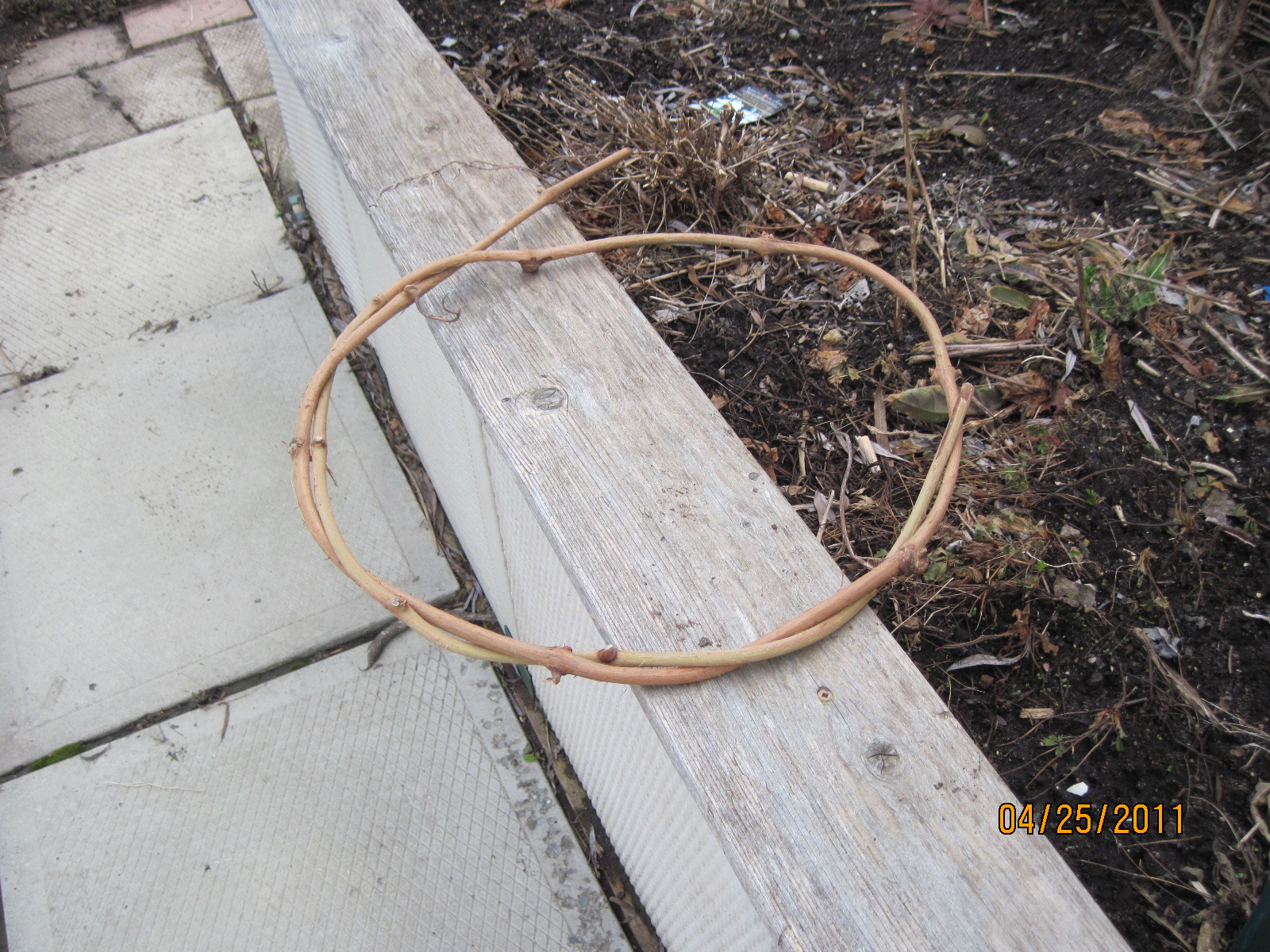

 Since the weather lately has not been conducive to sitting outside and stripping the loose bark from the cut grapevine vines, I chose two of the grapevine hoops I had to serve as the frame of a new rib basket. These hoops were approximately the same size in circumference, a similar colour, and similar in thickness. One hoop was placed inside the other at a 90 degree angle. The two hoops were then joined together by weaving "Gods Eyes" where the hoops intersected.
 The Gods Eyes provided an anchoring place into which to insert the white willow ribs. (White willow is willow harvested in the spring after the first flush of leaves occurs. At that time it is easy the strip the bark from the willow whips and reveal the white flesh beneath.) I placed five ribs in each of the two segments of the base. These were then secured into place by continuing weaving with the rattan cane from the Gods Eyes.
 For the Gods Eyes and the initial weaving of the basket I am using 1/4" rattan cane dyed with homemade natural walnut dye. Later I will use wider rattan cane and add more ribs to the basket. I will decide on the colour of this wider cane when I reach that stage.
 After another hour's work, I now have eight finished hoops of grapevine ready to use as frames for rib baskets. The vines needed to have their loose outer bark removed. If you click onto the photograph, you will see that the vines and hoops come in two colours: green and brown. For the green vines, all I needed to do was to remove that loose outer bark. However, the brown hoops needed more work since there was a loose, powdery coating beneath that loose bark that also had to be removed. A thorough scraping was all that was needed to finish the preparation.
 Now is the time to harvest the grapevine vines before the snow begins to fall. This photo shows the vines harvested from two grapevine plants that grew over an arch leading to the rear of our home. Each of these will need further processing by hand to remove the loose outer bark. Then a six to eight foot length can be formed into a hoop of one foot or more in diameter. Two such hoops form the frame for a rib basket.
 Ready for collection by the city are the thinner, unusable vines.
 This photo shows other grapevines I have yet to cut down and prepare for use.
 Here is what remains of one of the vines I did cut down.
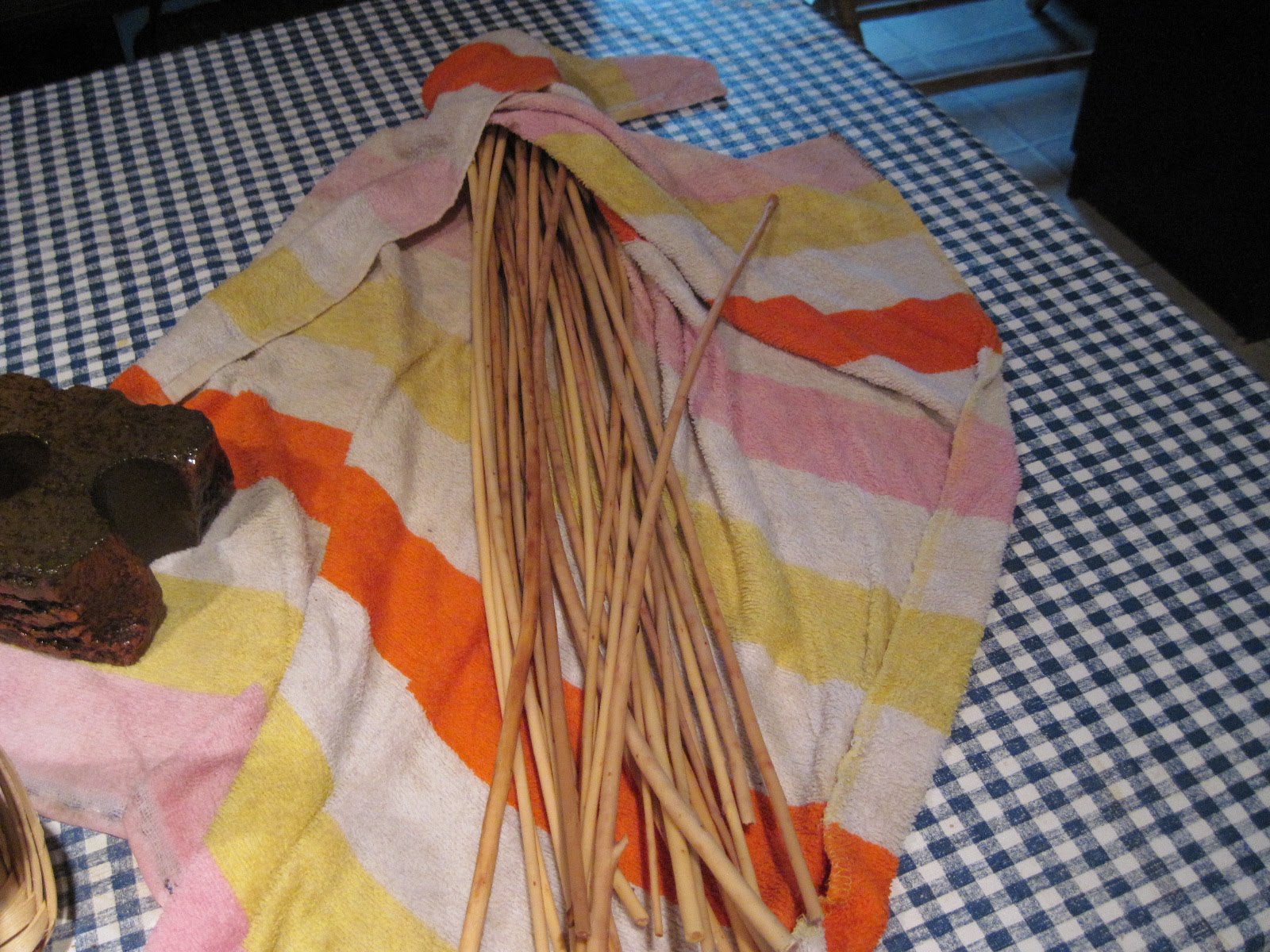 The white willow ribs soaked for about four days before being wrapped in a damp towel and allowed to "mellow" overnight. They proved to be supple enough to bend and put in place behind the God's Eyes without breaking.
 I took the remaining tail of the God's Eye weaving and wove it around the initial ribs I had in place. At this stage I usually place five ribs in each segment of the basket frame, alternating butt ends and tip ends. After weaving several rows of the 1/4" flat cane I judged it was now time to add more ribs.
 I added a second rib beside each of the five ribs in each segment. I also added a rib at both grapevine rims and on either side of the hoop that formed the intersection of the two woven segments. Weaving then went around these twenty-four ribs, the hoop and the rims.
 As you can see this weaving process nicely separates the ribs. The placing of the initial ribs, the weaving, the adding of more ribs and more weaving took around two hours of work. The 1/4" flat reed makes a very nice, solid and compact basket, but it does take a long time to see any major progress.
 After the successful use of walnut liquor as a dye yesterday, I decided to start making a rib basket using the newly dyed flat cane. The fact that the weather is somewhat miserable with rain and thunder showers was a major influence in this decision too.


 Over the last two or three days I have worked on adding two rib baskets to my Etsy shop. The photographs here compare and contrast those two baskets.

 It would not be a basket of mine,however, if it were to be completly uniform in shape. I always have some room for variability.