


 Since the weather lately has not been conducive to sitting outside and stripping the loose bark from the cut grapevine vines, I chose two of the grapevine hoops I had to serve as the frame of a new rib basket. These hoops were approximately the same size in circumference, a similar colour, and similar in thickness. One hoop was placed inside the other at a 90 degree angle. The two hoops were then joined together by weaving "Gods Eyes" where the hoops intersected.
 The Gods Eyes provided an anchoring place into which to insert the white willow ribs. (White willow is willow harvested in the spring after the first flush of leaves occurs. At that time it is easy the strip the bark from the willow whips and reveal the white flesh beneath.) I placed five ribs in each of the two segments of the base. These were then secured into place by continuing weaving with the rattan cane from the Gods Eyes.
 For the Gods Eyes and the initial weaving of the basket I am using 1/4" rattan cane dyed with homemade natural walnut dye. Later I will use wider rattan cane and add more ribs to the basket. I will decide on the colour of this wider cane when I reach that stage.
 The old saying, "You cannot see the wood for the trees" applied to my cane and willow storage area. Masses of tangled cane sat on top of, inside and under the storage bins I had for them. I could not see what was there and what was usable. Now I have salvaged all I could and hung them in skeins that are not only visible but easily reached and brought down.
 The remains of the unsalvageable mass sits at the roadside awaiting pick up for the City to compost.
 The rolls of ready-for-use cane are easily accessible and ready for dying as I use up the remnants.
 And the brown and white willow are also easily accessible for use in my rib baskets. Overall, yesterday was a successful day of re-organisation.
 As Fall approaches, I am beginning to work on the willow at the front of my side garden. Two years ago, I cut these willow shrubs to just above ground level. Anne wanted them to form a hedge or barrier for privacy, so I did not cut them down to ground level again this spring. Instead, I let them grow. Lately, I have begun to harvest from this two-year growth. As you can see, I cut the willow down to waist level from its 8 -12 foot height. the willow on the left is as yet uncut and shows its two-year height.
 Here are the remains of the cut willow that proved to be unusable for my basket-making. Most of these branches were too short or had too many branches off the main stem to be useful. I need long and straight "whips" for my basket ribs. I bundled up these waste products and put them at the curb for the green box compost recycling.
 For the usable willow whips, I stripped each of its leaves. The green bin was a helpful collection container for these.
 The end product after an hour or more of work: "brown" willow. These are now in my storage room where they will dry over the next weeks and months and lose their green colour. I will soak them in water before I can use them in my rib baskets.
 After going through a dry spell with no sales through my Etsy shop for a few weeks, today I mailed several rib baskets to a buyer in New York state.
 This one features grapevine handles and white willow ribs.
 Here is the result of harvesting the willow this spring season, while safeguarding Anne's desire to use the willow bushes/trees as a privacy fence too. The trash can contains white willow, willow whips stripped of their bark to reveal the white flesh beneath. The greenish tinge here will fade to a soft white as these whips dry.
 The willow tree in the fore of this photo is perhaps three years old. It has been allowed to grow without being trimmed to ground level for three years. It does form a significant privacy barrier.
 This is the same species of willow with its beautiful yellow bark and its leaves in tight clusters. Selected whips from this bush were cut for white willow. To ready it for stripping, I removed the leaves and then removed the bark. This is easy to do at his stage of growth with that first full flush of leaves being present.
 This is another species of willow that grows slender enough whips for me to use as ribs for my rib baskets. I need at least a two foot section of slender willow to use as ribs.
 In a few sections of the garden, I was able to cut the willow bushes down to near ground level. From this stool many slender whips will grow ready for next year's harvest.
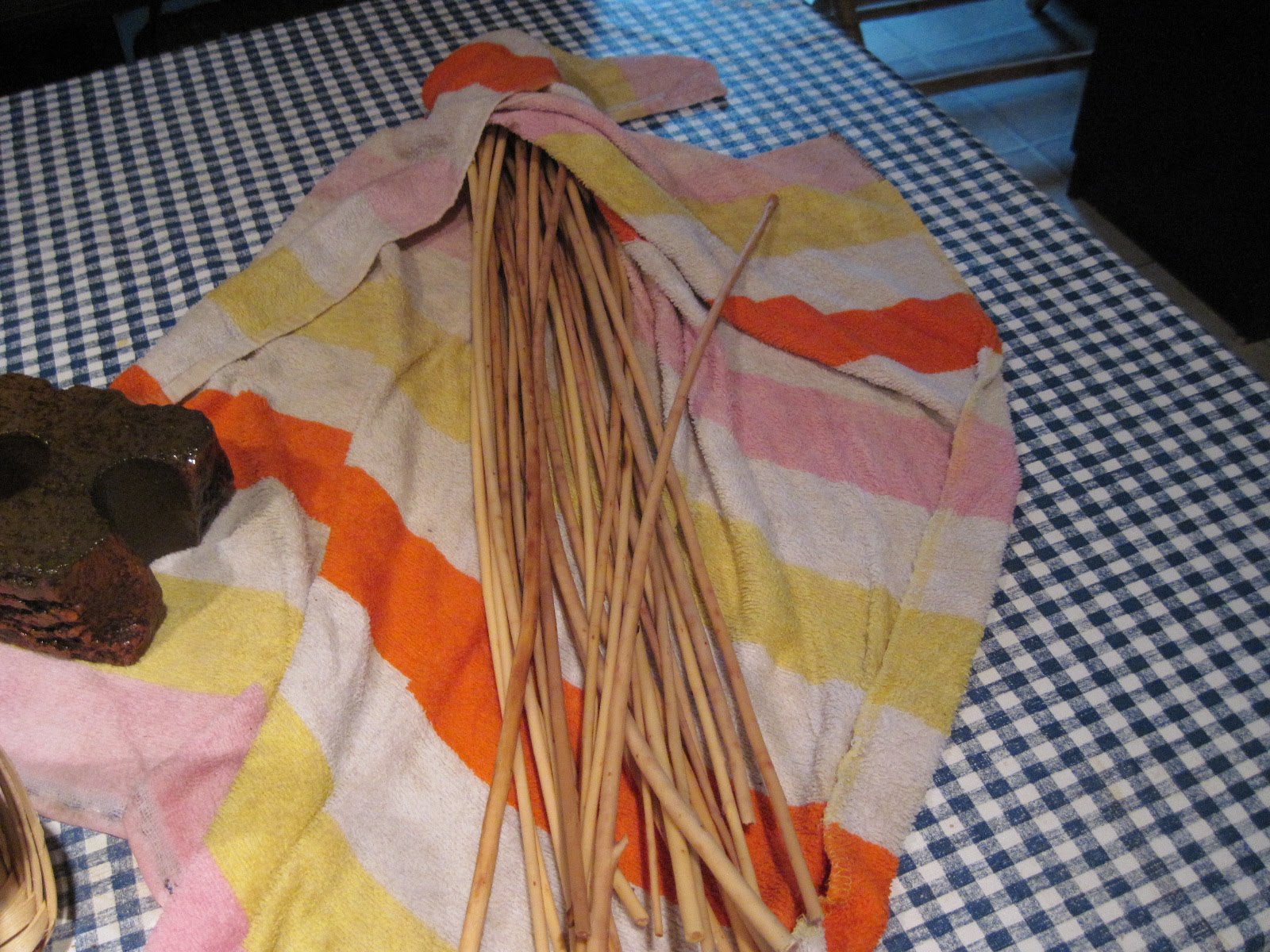 The white willow ribs soaked for about four days before being wrapped in a damp towel and allowed to "mellow" overnight. They proved to be supple enough to bend and put in place behind the God's Eyes without breaking.
 I took the remaining tail of the God's Eye weaving and wove it around the initial ribs I had in place. At this stage I usually place five ribs in each segment of the basket frame, alternating butt ends and tip ends. After weaving several rows of the 1/4" flat cane I judged it was now time to add more ribs.
 I added a second rib beside each of the five ribs in each segment. I also added a rib at both grapevine rims and on either side of the hoop that formed the intersection of the two woven segments. Weaving then went around these twenty-four ribs, the hoop and the rims.
 As you can see this weaving process nicely separates the ribs. The placing of the initial ribs, the weaving, the adding of more ribs and more weaving took around two hours of work. The 1/4" flat reed makes a very nice, solid and compact basket, but it does take a long time to see any major progress.
 Over the last two or three days I have worked on adding two rib baskets to my Etsy shop. The photographs here compare and contrast those two baskets.

 It would not be a basket of mine,however, if it were to be completly uniform in shape. I always have some room for variability.


.JPG)
.JPG) While the willow was soaking, I prepared the other materials. Two grapevine hoops of roughly equal size were found, and, in this case, pink rattan cane soaked in water to ready it for weaving.
While the willow was soaking, I prepared the other materials. Two grapevine hoops of roughly equal size were found, and, in this case, pink rattan cane soaked in water to ready it for weaving.
.JPG) The next step is to place the initial sets of ribs in place held by the God's eyes. I usually place five ribs on each side of the basket at this stage.
The next step is to place the initial sets of ribs in place held by the God's eyes. I usually place five ribs on each side of the basket at this stage..JPG)

