Several months ago I decided to retire from making baskets. While I still enjoy making them, I no longer enjoyed packing the shelving units, loading the baskets into totes tying the totes to the top of the car, driving to a venue, unloading and assembling, and then repeating the process again after the sale had finished. Via Kijiji I attempted to sell the supplies, shelves and other basket-making goods. The sales were somewhat successful in that the shelving units and booth floor coverings were sold. However, I had no offers for the basket-making materials them selves such as those in the totes above.
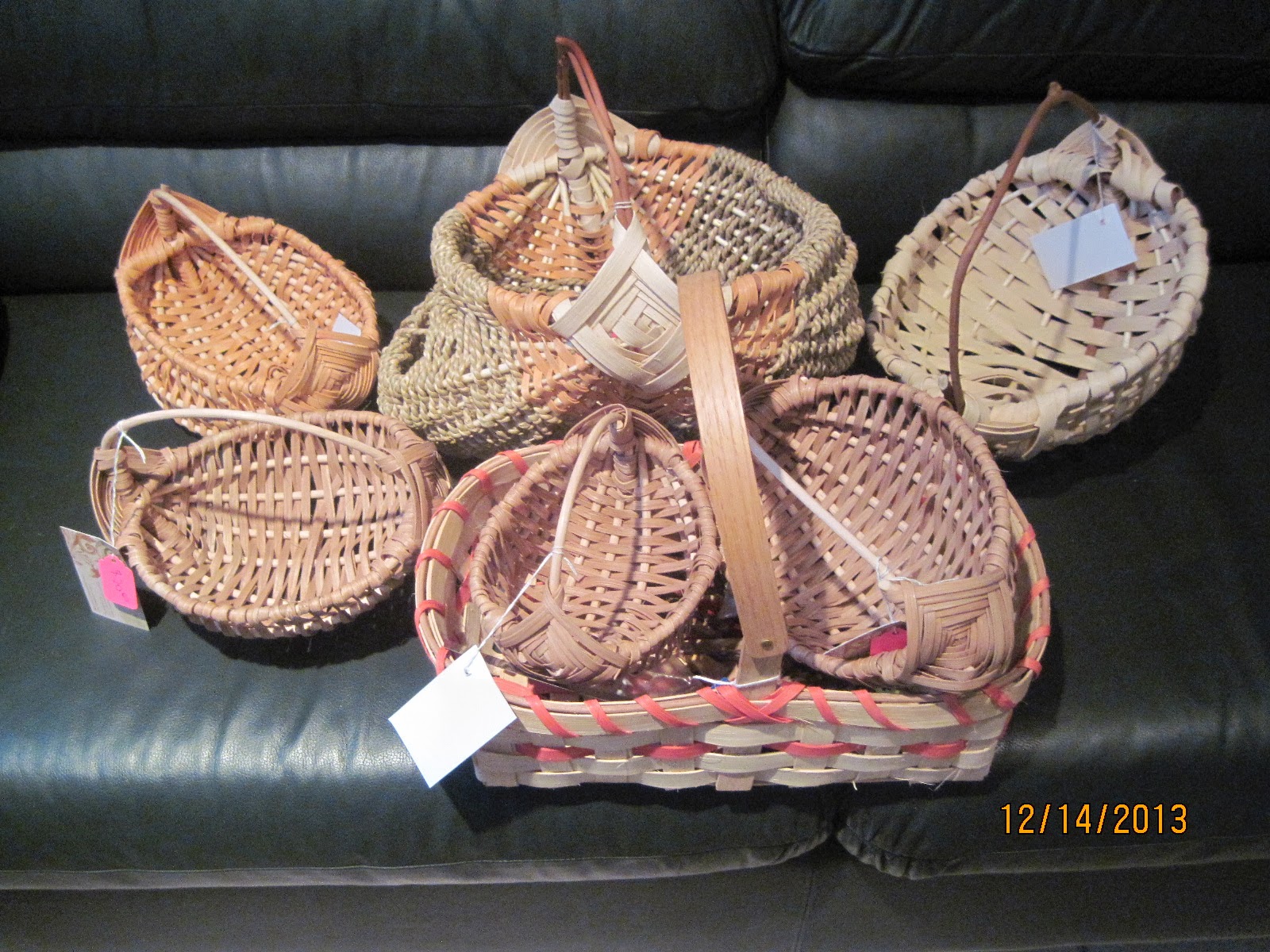
So, on Monday I fished out these materials and decided to make as many baskets as I could from these left over materials.
In six days I have been able to make a small dent in these supplies. I managed to make six rib baskets of various sizes as well as one swing-handled market basket. I have promised to take part in a sale on February 2nd at the new Richcraft recreation Centre put on by the local Chinese Seniors. Given the amount of left over material, I will likely have some still left by that date.
My favourite basket this week is this large rib baskets that is made from two hoops of grapevine, ribs of white willow and weavers of rattan cane and seagrass. I still have lots of grapevine hoops left, and enough white willow for two moare large rib baskets.
Showing posts with label seagrass. Show all posts
Saturday, December 14, 2013
Wednesday, February 13, 2013
The finished stair basket
I am quite pleased with the looks of this stair basket. My customer should be satisfied with the result. She wanted two such baskets without handles above the rim, and with seagrass weavers. She asked for holes at each end so she could lift it by putting her hands there. I could not figure out how to leave holes at each end with the seagrass and maintain the integrity of the basket, so I wove integrated handles instead.
This photo shows, in a close-up view, the integrated woven handle. A similar one is at the other end.
I am about to reweave the rim for the first basket I made to this design. The one inch flat cane and the round cane filler look so much better than the 1/2" flat cane and seagrass filler I used for the rim of that first basket. The one inch flat cane and sturdy round cane give much more strength to the rim. They also hold the shape much better. Once I have finished reworking the rim for that first basket, I will contact my customer so she can drop by and pick them up.
Labels:
baskets,
flat cane,
seagrass,
stair basket
Tuesday, February 12, 2013
Making another stair basket
I have almost completed making the second stair basket for a custom order. I work in the well lit studio in the basement
This basket is made from 1/2" flat cane, dyed brown for the stakes and bases. The weavers are seagrass.
The flat cane is dyed in lighter and darker brown for quite a pleasing affect. I will complete the basket tomorrow. New furniture was just delivered so I am planning to test out the recliner sofa all evening.
Labels:
baskest,
flat cane,
seagrass,
stair basket
Tuesday, January 22, 2013
Completing the stair basket.
At this stage, the stair basket's base level is almost finished.
Here the second level base is added and almost completed.
The finished basket sits on my stairs loaded down with two half house-bricks to help it retain an appropriate shape.
At the stage before I wove the border I was ready to say, "Never again will I make a stair basket with seagrass weavers." The basket looked quite mis-shapen and I worried about how I could get it to a decent shape. I placed the house-bricks in it overnight to try to shape it. In the middle of the night we were woken with a loud crash. In the morning I found the basket had fallen off the table and landed in the water-filled tote I use to soak the cane. This was the saving of the basket. I wove the border and found that the soaked basket was easy to manipulate into a decent shape. And, by placing it on the stairs with the half-brick weights, its shape was fine. It is now drying to that shape.
Labels:
baskets,
rattan cane,
seagrass,
stair basket
Monday, January 21, 2013
Beginning to weave a custom stair basket.
To make a stair basket I start with my pattern notes. These show the shape of the proposed basket and the dimensions of the various elements. From these dimensions I then cut the cane to size. For example, for the 'LONG SIDE' of the basket I need cane that is 66" long. This length is made up of 16.75" for the full depth of the basket, 8.25" for the width of the lower stair, 8.75" for the height of the stair, 8.25" for the width of the second stair, and 8" for the height of the second stair. Add to this two 8" sections for the weaving in of the top/border and you have the 66" total.
The tools I use are simple at the beginning stage. A ceramic tile to hold down the weavers as I interweave the horizontal and vertical sections, a tape measure, a straight edge ruler against which to bend the cane, scissors and a wooden implement to lift up cane so I can place ends beneath it.
To weave the base I used 1/2" and 3/4" flat cane dyed with coffee coloured dylon dye that was soaked to become more pliable.
The woven base is shown here with the 3/4" fillers tucked away.
The customer asked that I use seagrass as weavers. At this stage I have woven ten rows of seagrass for the base part of the stair basket. This base will sit on the lower stair.
Monday, November 19, 2012
Reworked hat stands.
The hat stands shown above were all reworked by tearing them apart until only their crowns were left. All needed to be reworked since they were too large to sell. Their circumferences were 23" or larger. Since the standard adult head circumference is 22", these as originally woven were not suitable for hat displays.
Each, on being rewoven, is now 22" in circumference or less. The hat stand on the left is made from round and flat rattan cane died a light brown with walnut dye. The central one has a darker walnut dye, but it will be lighter later when it dries. It also features sea grass for part of the body of the stand. The right hand hat stand is made from natural round and flat cane.
Labels:
baskets,
display head for hats,
hat stands,
rattan cane,
seagrass
Monday, October 15, 2012
Completing the seagrass rib basket.
The rib basket with seagrass weavers is now finished. I am quite pleased with the result.
To begin, I added five white willow ribs to each segment of the frame, ensuring that the inside hoop was the horizontal hoop. This meant that any weight on that inside hoop pulled it into the the decreasing circumference of the outside hoop.
The next step was to weave several rows with the seagrass around the ribs.
After six rows of weaving, I added another four ribs to each segment so that the spaces from rib to rib did not become too large.
These additional ribs were then separated as I continued with the weaving.
I tried to keep a balance between the weavings on each side.
Eventually, the weavings of the two sides met, but, as usual with the "make its own shape" grapevine the segments were not equal. If you look closely at the photo above you will see the far side rim of the basket has a gap of around four inches still to be woven while the near side segment is complete at the rim.
At this stage there are small gaps at the base that remain to be filled with weavers.
The finished basket .
Saturday, October 13, 2012
Using seagrass to make a rib basket
My regular rib baskets make use of flat cane for the God's eyes and weavers. Today's inspiration (?) is to use seagrass instead. I will use grapevine hoops as in the example above and white willow for the ribs.
To make a rib basket I choose two hoops of grapevine similar to these. Unlike these, I choose two of a similar size.
I then place one hoop inside the other and at right angles to it. I then join the two hoops with God's eye weavings. This gives me space behind which to insert the ribs.
The ribs I will use are currently in soak. They are of "white willow", that is willow that had its bark removed when I cut them down in the spring after the first flush of leaves appeared. I will be able to continue this project on Monday when I have free time for weaving once more.
Labels:
baskets,
grapevine,
seagrass,
white willow
Thursday, October 11, 2012
The finished Market Basket with seagrass weavers.
I finished the basket by adding the border. This is made from two circles of 1/2" natural cane, one on the inside top of the basket and one on the outside top. A circle of seagrass is then inserted between these two circles. Then I used 1/4" red-dyed flat cane to bind these to the top edge of the basket.
The close-up photo shows how the 1/4" cane binds the border together.
Wednesday, October 10, 2012
Weaving with the addition of seagrass.
With the model of an English Shopper before me, I began to get ready to weave a similar basket with seagrass as part of the weaving material.
The pre-cut stakes and fillers are shown here as well as the webbing loop.
Each of the stakes and filler were marked with an "X" to indicate the middle of each length. A 1/4" red-dyed stake was laid beneath a ceramic tile. The tike is for weight, with the "X" just showing at the edge of the tile. Then I added a 1/2" red filler followed by a 1/2" natural coloured stake. I then alternated filler, 1/4", filler, and natural stake as shown.
Using an under one and over one weaving pattern I placed a 1/2" natural stake at the line of "Xs". The mid-point "X" of this weaver was placed at the middle 1/2" natural stake. The 1/4" red stake was then woven with an over one and under one pattern.
As I wove in the third 1/2" natural stake, I also wove the webbing beneath it.
I then completed the base weaving by working its other side
The 1/2" fillers for the base were then woven into the base weave as shown.
Using clothes pegs as anchors, I then began to weave the sides.
Three rows of twining in red round cane added an embellishment to the basket, with green pony beads at each stake in the second row of this weaving.
Now I was able to see if the seagrass would be a good addition to my weaving repertoire. I feel it looks good.
I will complete the basket, now named as a market basket, tomorrow by adding its border.
Labels:
baskets,
English shopper,
market basket,
seagrass
Thinking outside the box (basket).
Several months ago, a basket-maker friend gave me the last of her supplies as she retired from basket making. Among the supplies were several unopened coils of seagrass. At that time I had only used a few strands of seagrass as fillers for the borders of market baskets. How was I to use this unexpected cache of seagrass?
One use I made of this supply was in the hat stand shown above. The texture and colour of the seagrass works quite well.
Today I am venturing into unknown territory for me. I have an eight foot piece of webbing that Anne sewed together in a loop to form the handles of an English Shopper. As you can see above I use that loop to go round the basket twice and then serve as the handles. Perhaps I can weave much of the body of a new basket with seagrass?
I found these "patterns" for an English Shopper as well as the model shown above. I pre-cut the stakes to the given dimensions. They are now in soak waiting for me to return to them later in the day. I will create more blogs as the work progresses. If the seagrass proves to be a good material for this kind of basket, I will be quite happy. If it does not, I will weave a similar shopper to the one shown.
Tuesday, September 18, 2012
A new hat stand.
Today's project was to weave a new hat stand. I used rattan cane, died brown and seagrass. I tried to make it 22" in diameter, adult size. It turned out slightly larger at 23". I will probably make several more of varying sizes before my next event at the Ottawa Knitters' Guild.
Subscribe to:
Posts (Atom)

